

Beginning with Auto Policy Quotes Explained: From Liability to Collision, the narrative unfolds in a compelling and distinctive manner, drawing readers into a story that promises to be both engaging and uniquely memorable.
As we delve into the intricacies of auto insurance policies, we uncover the nuances of coverage types and their significance in protecting your vehicle and financial well-being.
Understanding Auto Policy Quotes
When obtaining auto policy quotes, it's crucial to understand the different types of coverage included to make an informed decision about your insurance needs.
Types of Coverage in Auto Policy Quotes
- Liability Coverage: This covers costs associated with injuries or property damage you cause to others in an accident.
- Collision Coverage: This pays for damage to your vehicle in the event of a collision with another vehicle or object.
- Comprehensive Coverage: This covers damage to your vehicle from non-collision incidents like theft, vandalism, or natural disasters.
Examples of Coverage Differences
For example, if you were to cause an accident where another driver's car is damaged, liability coverage would help cover their repair costs. In contrast, collision coverage would cover the cost of repairing your own vehicle if you were at fault in a collision.
On the other hand, comprehensive coverage would come into play if your car was stolen or damaged by a falling tree.
Importance of Reviewing Coverage
It's essential to review and understand each type of coverage mentioned in an auto policy quote to ensure you have adequate protection in various scenarios. By knowing what each coverage entails, you can tailor your policy to meet your specific needs and budget, avoiding any surprises in the event of an accident.
Liability Coverage Explained
Liability coverage is a crucial component of an auto insurance policy that helps protect you financially in case you are responsible for causing injury or damage to others while driving. This coverage typically includes two main types: bodily injury liability and property damage liability.
Scenarios where Liability Coverage Comes Into Play
Liability coverage would come into play in various scenarios, such as:
- Causing an accident where someone is injured and requires medical treatment.
- Damaging someone else's property, such as their vehicle, a fence, or a building.
- Being sued for damages resulting from an accident where you are at fault.
Significance of Liability Coverage
Liability coverage is significant because it helps protect your assets and savings from being at risk in case you are found liable for causing harm to others. Without this coverage, you could be personally responsible for paying for medical bills, repair costs, and legal expenses, which could be financially devastating.
Minimum Liability Coverage Requirements Across States
The minimum liability coverage requirements vary across different states in the US. For example, some states may require a minimum of 25/50/25 coverage, which means:
“$25,000 bodily injury liability per person, $50,000 bodily injury liability per accident, and $25,000 property damage liability per accident.”
Other states may have different minimum limits, so it is essential to understand your state's requirements and consider purchasing higher liability limits for better protection.
Collision Coverage Details
Collision coverage is a type of auto insurance that helps pay for the cost of repairing or replacing your car if it is damaged in a collision with another vehicle or object.
What Collision Coverage Offers
- Collision coverage differs from comprehensive coverage in that it specifically covers damages resulting from collisions with other vehicles or objects, while comprehensive coverage covers damages from non-collision incidents like theft, vandalism, or natural disasters.
Filing a Claim and Coverage Details
- When filing a claim under collision coverage, you would typically need to provide information about the accident, including the date, location, and details of how it occurred.
- Collision coverage typically covers the cost of repairs to your vehicle or the actual cash value of your car if it is deemed a total loss after a collision.
- It may also cover damages to your vehicle caused by hitting potholes, guardrails, or other objects on the road.
Benefits of Collision Coverage
- Having collision coverage can be beneficial in situations where you are at fault for an accident, ensuring that your vehicle repair costs are covered without having to pay out of pocket.
- If you have a newer or more expensive vehicle, collision coverage can help protect your investment and provide peace of mind in case of an accident.
Comprehensive Coverage Overview
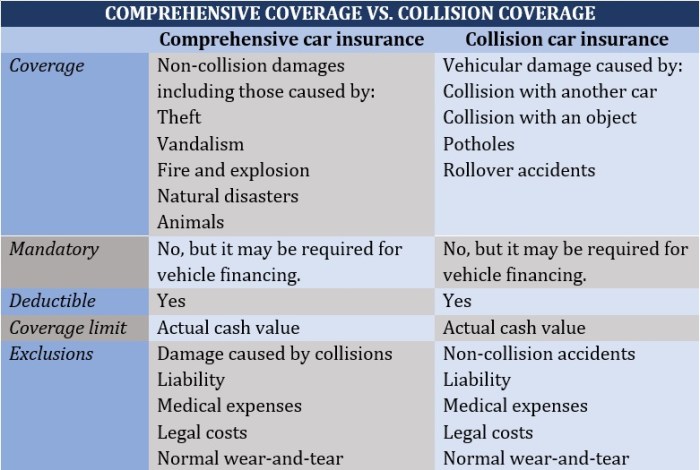
Comprehensive coverage is an essential component of an auto insurance policy that provides protection against a wide range of risks beyond just collisions.
What is included in Comprehensive Coverage?
- Damage from natural disasters such as hurricanes, tornadoes, or earthquakes.
- Theft or vandalism of your vehicle.
- Damage from falling objects like tree branches or hail.
- Animal collisions, such as hitting a deer or a bird damaging your car.
- Broken or shattered windows.
Types of Incidents Covered
- Comprehensive coverage typically covers incidents that are out of your control and not related to a collision with another vehicle.
- It provides financial protection for damages that may occur due to unpredictable events.
- Comprehensive coverage is beneficial for safeguarding your vehicle against a variety of risks beyond just accidents on the road.
Cost Differences between Collision and Comprehensive Coverage
Comprehensive coverage is generally less expensive than collision coverage because it covers a broader range of incidents that are less likely to occur. Since the likelihood of some events like theft or natural disasters is lower than a collision, the premium for comprehensive coverage is often more affordable.
Last Recap
Concluding our discussion on Auto Policy Quotes Explained: From Liability to Collision, we have navigated through the complexities of coverage options, shedding light on the importance of understanding each aspect to make informed decisions.
Detailed FAQs
What does liability coverage entail?
Liability coverage in an auto insurance policy protects you financially if you're at fault in an accident that causes injury or property damage to others.
How does collision coverage differ from comprehensive coverage?
Collision coverage specifically pays for damage to your vehicle from a collision with another vehicle or object, while comprehensive coverage covers damage from other incidents like theft, vandalism, or natural disasters.
What are the typical incidents covered under comprehensive coverage?
Comprehensive coverage usually includes damage from theft, vandalism, fire, falling objects, and natural disasters like floods or storms.


